 Kwenta
 Migration Timing and SNX Unlocks
Last updated ·Kwenta used one shared vesting calendar for its KWENTA-to-SNX migration, so later deposits didn’t restart the SNX lock. The conversion exchanged 1 KWENTA for 17 SNX under a three-month cliff followed by nine months of linear unlocks. The December 17, 2024 migration notice placed the start on November 12, 2024, with unlocks beginning February 12, 2025. A late deposit still required acceptance by the migration contract, and claiming remained distinct from depositing.
Full vesting removed the time lock on the SNX allocation, while a completed claim established receipt of SNX in the holder’s wallet.
KWENTA Deposits and SNX Claims
Liquid KWENTA in a wallet supplied the migration deposit, while staked and escrowed holdings needed release before they could enter that conversion. The December 2024 instructions placed unstaking before escrow release and deposit. They also stated that escrowed KWENTA automatically unstaked when it vested.
Depositing established the holder’s conversion allocation. A successful claim moved available SNX into the wallet. The receiving wallet’s SNX transfer record established receipt; an allocation figure alone described a right to claim.
The Three-Month Cliff
The three-month cliff kept SNX locked during the initial part of the shared calendar, before the linear unlock phase began. A zero claimable amount during the cliff was consistent with the lock, even when the deposit had succeeded.
Nine Months of Linear Unlocks
The following nine-month phase released the SNX allocation progressively across the common interval, ending when the full allocation had vested. A mid-period allocation could contain an unlocked portion alongside tokens that remained time-locked. Holders could claim that portion during the release phase without waiting for the entire allocation to unlock.
Which Dates Governed the SNX Unlocks?
The migration’s common lock began on November 12, 2024. Synthetix Exchange’s December 17, 2024 notice, The Kwenta Token Migration, used that start and placed the first unlocks on February 12, 2025.
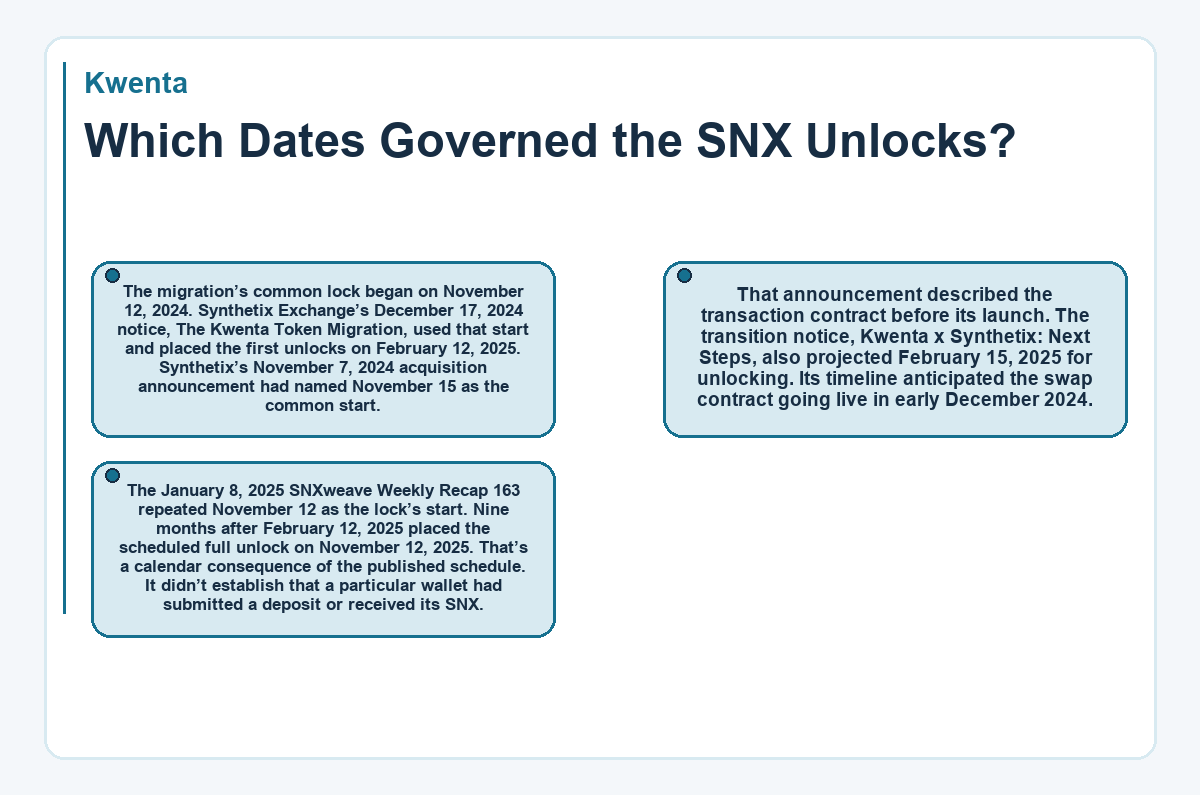
Synthetix’s November 7, 2024 acquisition announcement had named November 15 as the common start. That announcement described the transaction contract before its launch.
The transition notice, Kwenta x Synthetix: Next Steps, also projected February 15, 2025 for unlocking. Its timeline anticipated the swap contract going live in early December 2024.
The January 8, 2025 SNXweave Weekly Recap 163 repeated November 12 as the lock’s start.
Nine months after February 12, 2025 placed the scheduled full unlock on November 12, 2025. That’s a calendar consequence of the published schedule. It didn’t establish that a particular wallet had submitted a deposit or received its SNX.
Later Deposits and Remaining Entitlement
A late deposit inherited the portion of the common schedule that had already elapsed, subject to the migration still accepting that deposit. Joining during linear vesting meant that an allocation could already include unlocked SNX. Joining after the scheduled final unlock meant the time restriction had ended for the whole allocation. Neither case restarted the cliff or established unlimited eligibility to submit new tokens.
Previously claimed SNX affected what remained to receive. The ratio determined the total allocation attributable to deposited KWENTA; earlier distributions reduced the outstanding amount. Calendar progress answered how much of that total had vested. A lower claimable balance than the full conversion amount could therefore reflect earlier claims.
A Hypothetical Deposit After Full Unlock
Consider a hypothetical wallet holding 26 liquid KWENTA after November 12, 2025, with no earlier migration deposit or SNX claim. Assume the tokens match the migration contract’s supported token and network, and that it still accepts deposits. The holder wants the full conversion without starting another lock. Reviewing the wallet balance and proposed transaction doesn’t commit the tokens, so the holder can stop before submitting the conversion.
The documented ratio gives 26 × 17 = 442 SNX. All 442 SNX fall beyond the schedule’s time restriction in this case. Before authorizing the deposit, the holder reviews its amount, network, and destination contract. Under the acquisition terms, a completed conversion burns the deposited KWENTA.
An accepted deposit establishes the 442-SNX allocation; the holder then claims the available tokens. The completed claim and a 442-SNX transfer into the receiving wallet establish receipt. The calculated 442-SNX entitlement alone wouldn’t establish that outcome. Changing the deposited amount changes the entitlement proportionally. Changing an otherwise eligible late-deposit date doesn’t restart the shared calendar.
Two Meanings of Vesting
Escrow release concerned KWENTA from the former rewards system; migration vesting concerned the SNX allocation that resulted from token conversion. The transition made escrowed KWENTA available for penalty-free release from November 20, 2024. Releasing it produced liquid KWENTA in the wallet. That operation didn’t itself complete the conversion into SNX or replace the common SNX schedule.
An escrow vest record could explain where wallet KWENTA came from without showing a migration deposit. Confusing those records could make a completed escrow release look like missing SNX.
Why Haven’t My Unlocked SNX Tokens Reached My Wallet?
Unlocked SNX still required a claim, so a completed calendar alone didn’t prove that a wallet had received its tokens. A deposit record answered whether KWENTA entered conversion. A claim record answered whether available SNX left the allocation for the holder. An absent deposit or an unclaimed allocation could explain why no migration SNX had arrived. An earlier completed claim called for checking the SNX transfer into the receiving wallet.
A submitted transaction also differed from a successful token transfer. A pending or unsuccessful claim couldn’t establish receipt. The relevant endpoint was the SNX transfer into the receiving wallet, considered alongside the remaining claimable balance.
The Separate Submission Window
The acquisition terms included a two-year limit for sending KWENTA into the conversion contract, separate from the shorter lock-and-vesting calendar. Synthetix’s November 7, 2024 acquisition announcement said KWENTA that holders hadn’t submitted after two years wouldn’t convert into SNX. It didn’t add two years of vesting or turn the final unlock date into a new submission deadline.
The two-year wording didn’t specify an exact cutoff date or time. Its duration alone couldn’t establish whether a fresh deposit remained acceptable at a later date. Full vesting removed the calendar restriction on an allocation, while unconverted holdings still depended on acceptance into the migration. An existing claim balance concerned tokens that had already entered conversion; new-deposit eligibility answered a different question.
The Halt in KWENTA Reward Accrual
The transition halted KWENTA inflation, paused new staking entries, and stopped rewards on existing staked KWENTA on November 15, 2024. Those changes concerned the former rewards program. They didn’t add a yield component to the fixed conversion ratio. The halt explained why an old staking balance could remain visible without accruing new KWENTA rewards.
Token Holdings After the Rebrand
The transition to Synthetix Exchange retired the former DAO and brand in December 2024, while individual token holdings still required their own conversion. A changed interface name didn’t demonstrate that a wallet had deposited KWENTA or claimed SNX. Legacy Smart Margin accounts and limit orders concerned trading activity, with balances and execution rules distinct from the token migration.
Questions and answers about Kwenta
Did Trading Activity Set the KWENTA-to-SNX Allocation?
The token conversion calculated SNX from deposited KWENTA, so trading volume didn’t determine that allocation. It didn’t calculate a reward from the number of trades, a position’s size, or its trading profit.
Was SNX Staking Required Before Migration Tokens Could Unlock?
The migration’s unlock schedule didn’t require holders to stake their resulting SNX. The migration notice described staking and governance as things that holders could do with SNX, while the cliff and linear unlocks followed the common calendar. A later staking decision carried its own rules and didn’t establish the start date for this token conversion.
Were Network Transaction Charges Part of penalty-free Escrow Release?
The fee waiver concerned the early-vesting penalty on escrowed KWENTA, not every cost associated with a blockchain transaction. The transition set that penalty to 0%, and the migration instructions described escrow release without a vesting fee. A network execution charge, if applicable to the transaction, was a separate cost. The waiver didn’t supply a fixed gas estimate.
Could a Support Message Offer an Earlier SNX Unlock?
A support message couldn’t change the migration’s shared vesting dates. The transition’s security notice said core contributors would never initiate a direct message and routed support through ticket channels. A seed phrase wasn’t part of the documented unstake, escrow release, deposit, or claim process and shouldn’t leave the wallet owner’s control.
Did the treasury’s KWENTA Burn Prove That Individual Migrations Were Complete?
The treasury burn didn’t prove that individual holders had deposited KWENTA or received SNX. SNXweave Weekly Recap 161, published December 11, 2024, reported that the Synthetix Treasury burned 87,000 KWENTA from the non-circulating supply. A holder’s accepted conversion and completed claim had their own records, independent of the aggregate burn.