 Kwenta
 Perps Trading and the Synthetix Merger
Last updated ·Kwenta was a non-custodial perpetual futures marketplace that Synthetix acquired to reunite its trading interface with the underlying liquidity protocol. It offered contracts without a fixed expiry across Optimism, Base, and Arbitrum. The acquisition announcement came in November 2024. Synthetix later shifted its trading focus to an order-book exchange on Ethereum Mainnet. Older margin tools, the KWENTA token conversion, and the newer exchange belong to distinct parts of that transition, with different implications for trading accounts and token holdings.
The short version: KWENTA conversion terms governed token holdings, while the newer Ethereum Mainnet exchange introduced a different trading architecture.
Trading Interface, Liquidity Engine, and Token
The trading interface, its underlying liquidity engine, and the KWENTA token had different jobs within the original platform. The frontend presented markets and account controls, while integrated derivatives protocols supplied the trading infrastructure. Synthetix powered the original derivatives markets; the marketplace also integrated Perennial. Kwenta’s November 2024 transition notice scheduled the end of its Perennial support for November 28, 2024. It directed users to Perennial to manage those positions. When more than one integration existed, the network name alone couldn’t identify the rules that applied to a position, because the market’s provider and the engine that the account used also mattered.
KWENTA belonged to the project’s token and governance system. Its merger terms addressed token holdings, separately from the contracts that held trading margin.
Legacy Perpetuals and Margin Tools
Legacy trading tools supported leveraged directional positions, with margin and order handling determined by the selected engine.
Perpetual Futures Exposure
A perpetual position tracked an underlying asset’s price without a fixed expiry. Long exposure benefited from rising prices, while short exposure benefited from falling prices, before costs. Leverage increased exposure relative to collateral, amplifying gains and losses. These contracts provided price exposure without requiring ownership of the underlying asset.
Smart Margin Accounts
Smart Margin was an on-chain account engine for Synthetix-powered derivatives. It supported ordered commands that traders could batch within one transaction. That account structure connected margin management with position changes across supported markets.
Margin Commands
The command system could move margin and modify position size across markets. Ordered execution let earlier commands supply the state and funds that later commands needed.
Conditional Orders
The legacy Optimism integration used Gelato keepers for conditional orders, including limit and stop-market orders. Keeper execution involved both the order’s conditions and the account’s funding for network transaction costs.
The Merger and Exchange Transition
The merger changed ownership before the later Mainnet redesign changed the trading architecture. Synthetix announced its acquisition of Kwenta on November 7, 2024. The transition unfolded through separate changes to token incentives, escrow access, branding, and the exchange.
| Transition Stage | Timing | Documented Change | Scope or Limitation |
|---|---|---|---|
| Frontend Separation | 2020 | Kwenta and Synthetix separated their activities. | The interface retained its relationship with Synthetix derivatives. |
| Acquisition Approval | November 2024 | The councils approved reunification through SIP-411 and KIP-138. | Holder conversion had separate lock and vesting terms. |
| Inflation Shutdown | November 15, 2024 | KWENTA inflation and new staking entries stopped. | Existing staked tokens stopped earning rewards. |
| Escrow Release | Reported complete by November 20, 2024 | Existing KWENTA escrow became releasable without an early vesting penalty. | Removing that penalty didn’t remove blockchain transaction costs. |
| Treasury Token Retirement | Reported December 11, 2024 | Synthetix reported burning the non-circulating KWENTA supply. | This report concerned treasury tokens, not every holder’s balance. |
| Exchange Relaunch | December 2024 | The frontend adopted Synthetix Exchange branding. | The rebrand preceded the later Ethereum Mainnet trading engine. |
| Mainnet Trading Launch | Fourth quarter of 2025 | Synthetix launched its Mainnet order-book exchange in private beta. | That launch milestone described private beta, not unrestricted account access. |
How Did KWENTA Convert to SNX?
The holder conversion exchanged burned KWENTA for an SNX allocation subject to the merger’s release schedule. The 2024 acquisition terms set the conversion ratio at 17 SNX for each 1 KWENTA. Those terms specified a three-month lock followed by nine months of linear vesting. The program used a shared schedule, so a later deposit didn’t start a fresh lock. Holders could claim the portion that had vested during the vesting period. The announcement also described a two-year submission cutoff, distinct from the lock and vesting period.
The submission window governed sending tokens into the conversion contract. Vesting governed when the resulting SNX allocation became available.
Ethereum Mainnet and the New Order Book
The newer Synthetix exchange changed both the network and the execution model associated with the legacy trading frontend. Synthetix’s March 13, 2026 roadmap reported that it had deprecated its L2 automated market makers and consolidated trading around an Ethereum Mainnet order-book venue.
Earlier Synthetix trading used protocol liquidity and oracle-based pricing without an order book. The later venue organized trading around an order book. A historical description of one model therefore doesn’t describe the other model’s execution mechanics or account requirements.
Position Costs and Liquidation
Legacy perpetual positions combined trading costs with funding and collateral requirements. Funding could create a payment or a receipt depending on the position’s direction and the rate’s sign, so holding a contract without an expiry didn’t establish a fixed cost of keeping it open. Funding used notional position size, so leverage increased its effect relative to posted collateral. Paying funding could reduce the margin available to support a position even without an adverse price move. Liquidation concerned insufficient supporting margin; non-custodial access didn’t remove that mechanism. Fees, funding, and network transaction costs served different purposes, and settings from an old Optimism deployment weren’t universal parameters for later products.
Migration Support and Wallet Access
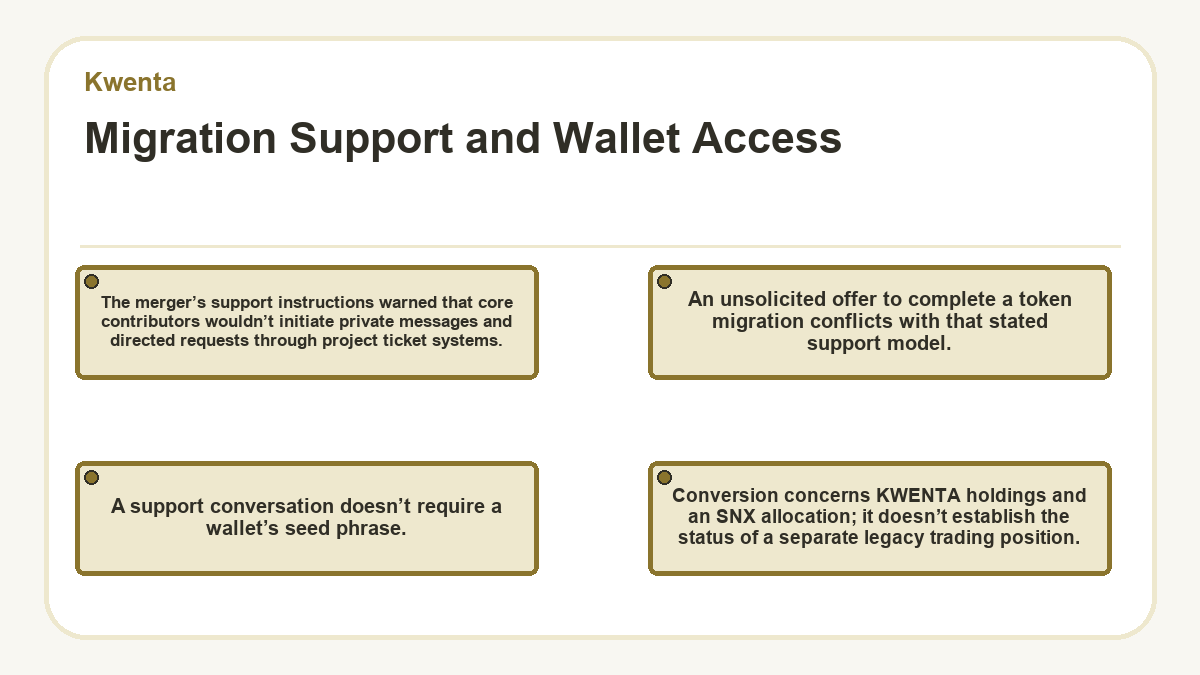
The merger’s support instructions warned that core contributors wouldn’t initiate private messages and directed requests through project ticket systems. An unsolicited offer to complete a token migration conflicts with that stated support model. A support conversation doesn’t require a wallet’s seed phrase. Conversion concerns KWENTA holdings and an SNX allocation; it doesn’t establish the status of a separate legacy trading position.
Kwenta: common questions
Which Assets Did the Legacy Optimism Trading Setup Require?
The original Optimism setup required sUSD as trading collateral and ETH for gas in a connected wallet. sUSD supported the derivatives position, while ETH paid blockchain transaction costs. These requirements belonged to the legacy Optimism deployment, whose infrastructure differed from the newer Ethereum Mainnet exchange.
Was the Fixed Conversion Ratio a Guarantee of Equal Dollar Value?
The fixed ratio specified token units, not a guaranteed dollar value. An allocation of 17 SNX per KWENTA didn’t fix the market price of either token. The value of the allocation depended on SNX’s market price.
Did the Project Treasuries Receive SNX for Their KWENTA?
The acquisition announcement specified that neither project’s treasury would convert its KWENTA into SNX. Their treasury holdings followed a burn-only arrangement. That exception separated treasury token retirement from the holder conversion and its associated SNX allocation.
What Changed for the Former Points and Referral Programs?
The November 2024 transition plan outlined replacement or retirement of the former incentive programs. It marked points for a pause and closeout, while VIP benefits and the legacy referral program remained active at that stage. The team planned changes to VIP benefits and a replacement referral scheme.
Is a limit-order Trigger the Same as a Guaranteed Fill Price?
The legacy Smart Margin order flow distinguished a trigger condition from the eventual execution price. Its documentation allowed fills to vary with the oracle price when delayed execution completed. Reaching the trigger alone therefore didn’t guarantee a fill at the displayed trigger or chart price.
Why Could the Old dashboard’s Market and Index Prices Differ?
The legacy Smart Margin dashboard displayed an index price and a market price with different meanings. The index reflected the underlying oracle price. The market price included a premium or discount related to market skew, so the two displays didn’t necessarily show the same value.
Where Did Governance Responsibility Move After the Merger?
SIP-411 assigned the former Kwenta governance responsibilities to the Synthetix Spartan Council. The acquisition also brought the treasury and operations into Synthetix. Historical Kwenta Council decisions belonged to the platform’s earlier governance period.